
Loading...
Loading...
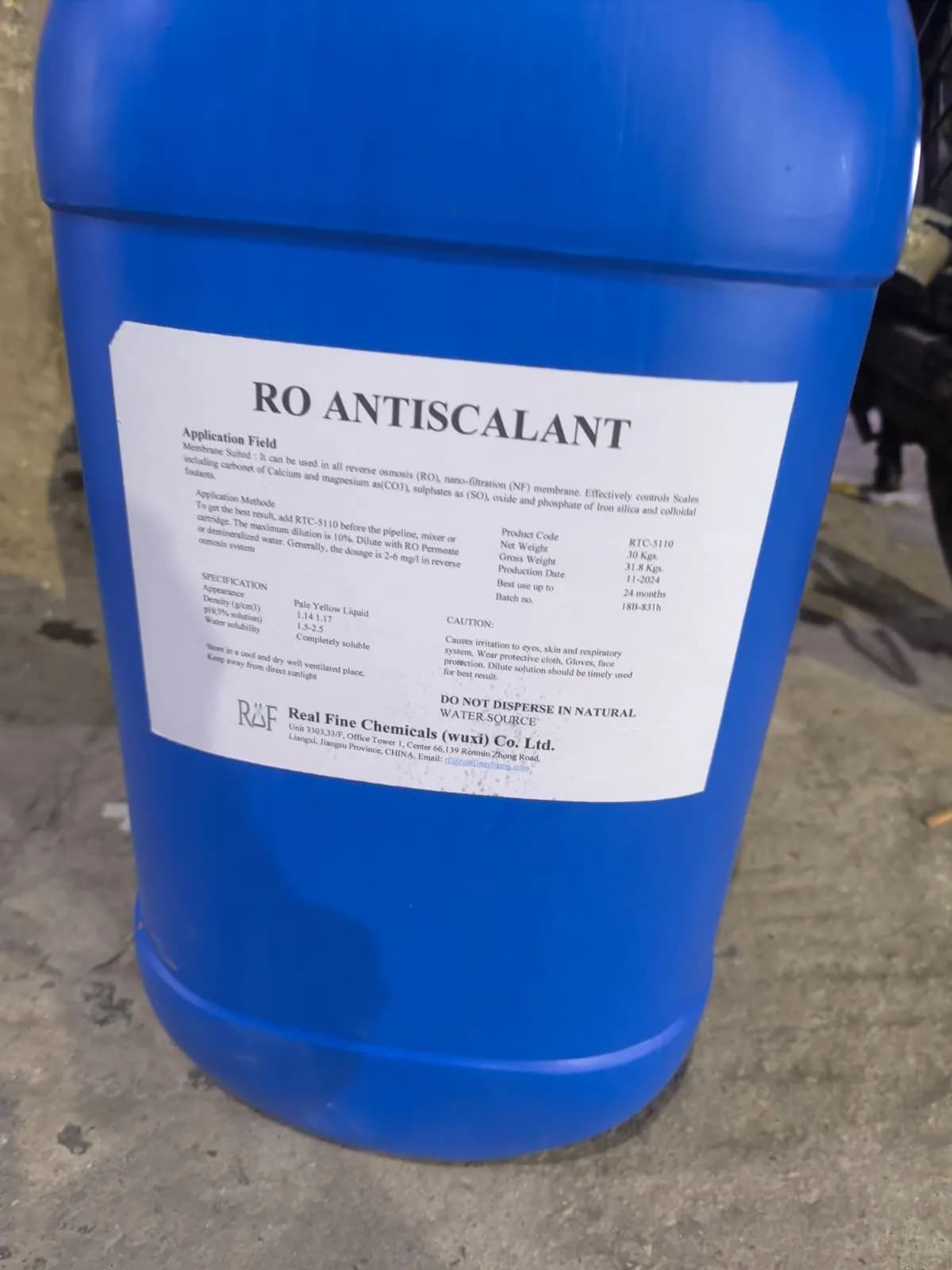
RO Antiscalant (RO অ্যান্টিস্কেল্যান্ট) | High-Performance Reverse Osmosis Membrane Antiscalant for Water Treatment & Industrial RO Systems
Pack Size:
RO Antiscalant is a specialized water-treatment chemical designed to help prevent the formation and deposition of scale on Reverse Osmosis (RO) membranes. It helps control common mineral scale-forming compounds such as calcium carbonate, calcium sulfate, and other sparingly soluble salts, supporting stable RO performance, membrane efficiency, and longer membrane service life.
| Specification | Details |
|---|---|
| Product Name | RO Antiscalant |
| Product Type | Reverse Osmosis Membrane Antiscalant |
| Physical Form | Liquid |
| Appearance | Clear to Pale Yellow Liquid (Grade Dependent) |
| Odor | Mild / Characteristic |
| Solubility | Miscible/Dispersible in Water |
| Main Function | Scale Inhibition & Dispersancy |
| Typical Target Scales | Carbonate, Sulfate & Selected Silica-Related Deposits |
| pH | Manufacturer/Grade Specific |
| Density | Manufacturer/Grade Specific |
| Concentration | Manufacturer/Grade Specific |
| Compatibility | Suitable RO Membrane Systems as Specified by Manufacturer |
| Storage | Cool, Dry Place Away from Direct Sunlight |
RO Antiscalant is a concentrated water-treatment chemical formulated to minimize the formation of inorganic scale on Reverse Osmosis (RO) membranes. It is widely used in commercial, industrial, and municipal RO water-treatment systems where feed water contains dissolved minerals that can precipitate and accumulate on membrane surfaces.
During RO operation, dissolved salts become concentrated on the feed side of the membrane. Under unfavorable conditions, these salts can exceed their solubility limits and form deposits such as calcium carbonate, calcium sulfate, barium sulfate, strontium sulfate, and silica-related scale. Scaling can reduce membrane performance, increase operating pressure, decrease permeate flow, and increase cleaning frequency.
RO Antiscalant works by interfering with the formation and growth of scale-forming crystals and helping keep certain mineral components dispersed in the feed water. The exact performance depends on the feed-water chemistry, membrane type, recovery rate, temperature, pH, and antiscalant formulation.
It is suitable for a wide range of commercial and industrial RO systems, including drinking-water treatment, process-water treatment, boiler-feed pretreatment, industrial wastewater reuse, and desalination applications.
Applications / Uses
Used for:
Suitable for appropriately designed:
For potable-water production, use only an antiscalant specifically approved/certified for the intended application.
RO Antiscalant can be used in selected:
Appropriately formulated antiscalants are used in:
The product must be selected according to the feed-water chemistry and membrane manufacturer's requirements.
Common Scale Problems Controlled
Depending on the specific formulation, RO Antiscalant may help control:
Not every antiscalant controls every type of scale. Always select the product based on feed-water analysis and the manufacturer's performance data.
Typical Dosage
The correct dosage should be determined based on:
A common preliminary dosage range for many commercial formulations is approximately 1–5 ppm, but the actual requirement may be lower or higher.
For industrial RO systems, determine the dosage using:
Feed-Water Analysis → Scaling Calculation → Antiscalant Selection → Jar/Bench Testing → RO System Optimization
For accurate dosing, follow the manufacturer's TDS and, where available, use an RO projection/scaling calculation.
How to Use
RO Antiscalant is generally dosed continuously into the RO feed-water line before the RO membranes.
Typical dosing arrangement:
Raw Water → Pretreatment → Antiscalant Dosing → Cartridge Filter → RO Membrane → Permeate
The antiscalant should be properly diluted and injected using a calibrated dosing pump when required.
Benefits for RO Systems
Properly selected and dosed RO Antiscalant can help:
Storage Instructions