
Loading...
Loading...
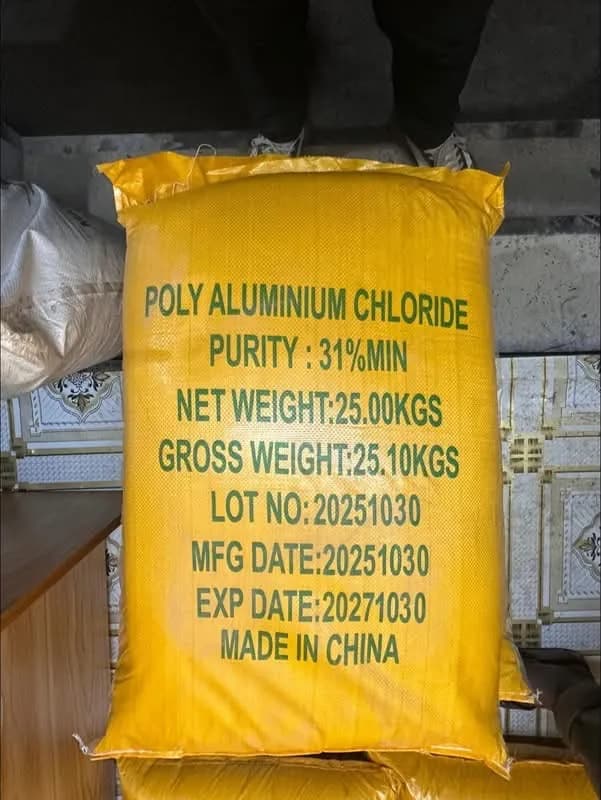
Poly Aluminium Chloride (PAC) (পলি অ্যালুমিনিয়াম ক্লোরাইড) | High-Performance Water Treatment Coagulant for Drinking Water, Wastewater & Industrial Applications
Pack Size:
Poly Aluminium Chloride (PAC) is a highly effective inorganic coagulant widely used for water purification, wastewater treatment, ETP/STP systems, drinking water treatment, and industrial water clarification. It helps destabilize suspended particles and impurities, allowing them to form larger flocs that can be efficiently separated from water.
| Specification | Details |
|---|---|
| Product Name | Poly Aluminium Chloride |
| Abbreviation | PAC |
| Chemical Type | Inorganic Aluminium-Based Coagulant |
| Appearance | White, Yellowish or Light Yellow Powder / Solid (Grade Dependent) |
| Form | Powder / Liquid |
| Main Active Component | Aluminium-based Polychloride |
| Al₂O₃ Content | Typically 28–31% for many high-quality powder grades (varies by product) |
| Basicity | Typically 40–90%, depending on grade |
| pH | Grade and concentration dependent |
| Water Solubility | Readily Dispersible/Soluble in Water |
| Main Function | Coagulation & Flocculation |
| Grade | Drinking Water / Industrial / Wastewater Grade, depending on product |
| Packaging | As Available |
| Storage | Cool, Dry & Well-Ventilated Place |
Poly Aluminium Chloride (PAC) is a widely used aluminium-based coagulant designed for efficient water clarification and wastewater treatment. It works by neutralizing the electrical charges of suspended particles and colloidal impurities, allowing them to aggregate into larger flocs that can then be removed through sedimentation or filtration.
PAC is commonly used in municipal water treatment, drinking water purification, industrial wastewater treatment, ETP (Effluent Treatment Plant), STP (Sewage Treatment Plant), textile wastewater treatment, paper manufacturing, food-processing wastewater, and many other industrial applications.
Compared with conventional coagulants such as aluminium sulfate (alum), PAC can provide effective coagulation over a broader range of operating conditions and may require lower dosing in some applications. Performance depends strongly on the PAC grade, basicity, raw-water characteristics, pH, turbidity, organic load, and treatment process.
PAC is available in powder and liquid forms, with different aluminium oxide content and basicity levels. Selecting the correct grade is important for achieving optimum floc formation and water clarification.
Applications / Uses
Appropriately certified water-treatment-grade PAC can be used for:
For potable-water applications, only PAC meeting the relevant drinking-water treatment specifications and regulatory requirements should be used.
2. Industrial Wastewater Treatment
PAC is widely used in industrial ETP systems for:
It helps remove suspended solids, colloidal materials, and certain color-causing substances.
3. ETP (Effluent Treatment Plant)
PAC is commonly used as a primary coagulant in ETP processes.
Typical treatment sequence:
Wastewater → pH Adjustment → PAC Dosing → Rapid Mixing → Flocculation → Sedimentation → Filtration
The actual process may vary depending on the wastewater characteristics and treatment plant design.
4. STP (Sewage Treatment Plant)
PAC can be used in selected sewage-treatment processes for:
5. Textile Industry
PAC is particularly useful in wastewater treatment for:
6. Paper & Pulp Industry
Used for:
7. Other Applications
Depending on the grade and treatment process: